
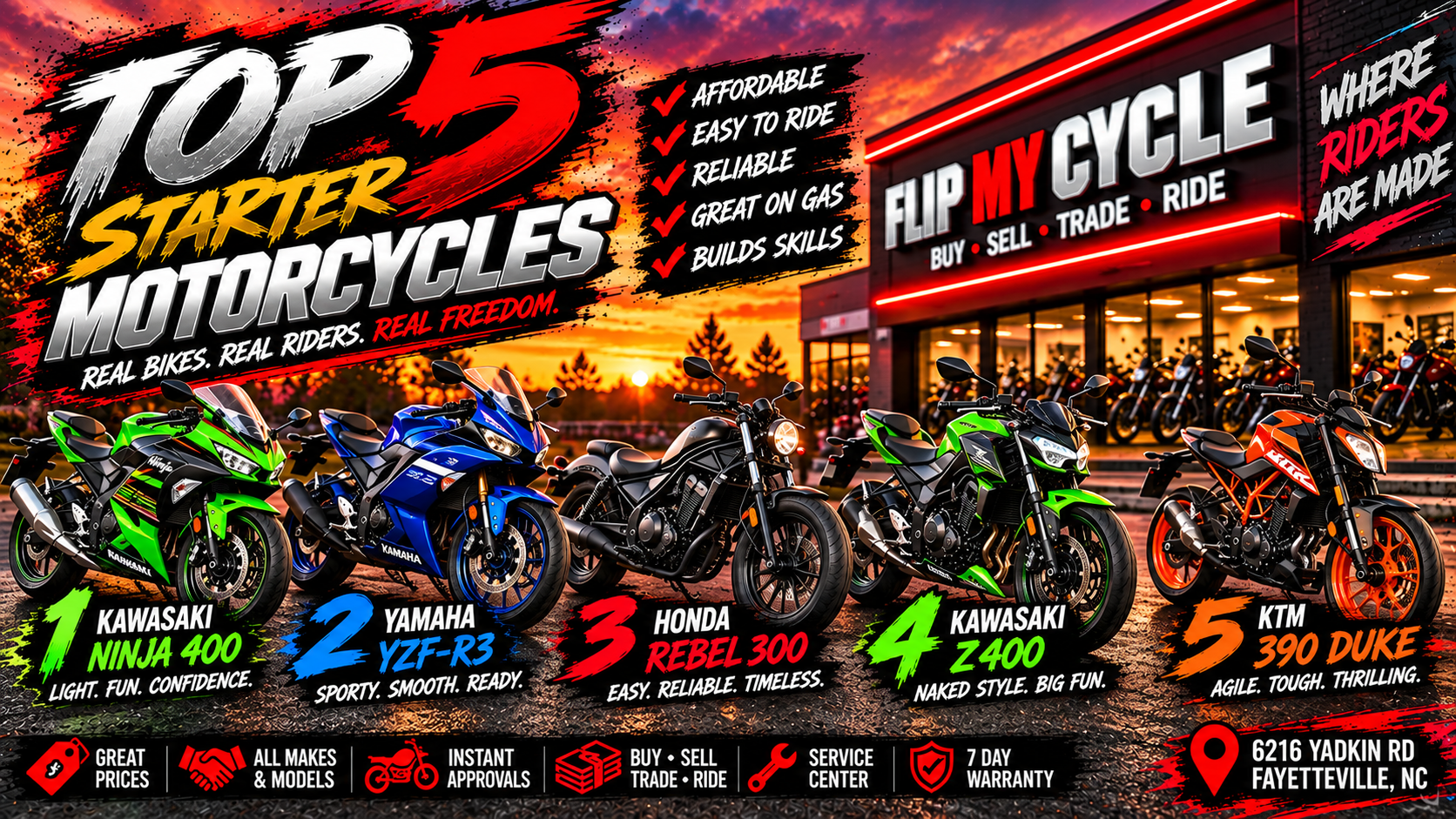
Best Starter Motorcycles: Top 5 Bikes for New Riders
Best starter motorcycles aren’t necessarily the fastest, biggest, or most expensive motorcycles in the showroom. A great first motorcycle should help a new rider build confidence, practice fundamental skills, learn throttle and clutch control, and actually enjoy riding without feeling overwhelmed by unnecessary power or weight.
At Flip My Cycle in Fayetteville NC, we see riders at every experience level.
Some have been riding for decades.
Others are shopping for their very first motorcycle.
And one of the most common questions new riders ask is:
“What’s the best motorcycle to start on?”
There isn’t one perfect answer for every rider.
Your height matters.
Your inseam matters.
Your experience matters.
Your budget matters.
And most importantly, the type of riding you plan to do matters.
But there are motorcycles that consistently make strong choices for riders who are learning.
Here are five of our favorite types of starter motorcycles to consider.
Table of Contents
- What Makes a Good Starter Motorcycle?
- #1 Kawasaki Ninja 400
- #2 Yamaha YZF-R3
- #3 Honda Rebel 300
- #4 Kawasaki Z400
- #5 KTM 390 Duke
- Sportbike or Cruiser for a Beginner?
- Why Bigger Isn’t Always Better
- Used vs. New Starter Motorcycles
- ABS for a First Motorcycle
- What Should Your First Motorcycle Cost?
- Motorcycle Gear for New Riders
- Take a Motorcycle Safety Course
- Starter Motorcycles Around Fayetteville NC
- Find Your First Motorcycle at Flip My Cycle
What Makes the Best Starter Motorcycles?
Before talking about individual motorcycles, it’s important to understand what makes a motorcycle beginner-friendly.
A first motorcycle should help you learn.
It shouldn’t make every mistake more difficult to manage.
Some important characteristics include:
- Manageable power
- Predictable throttle response
- Reasonable weight
- Comfortable ergonomics
- Easy low-speed handling
- Accessible seat height for the individual rider
- Good braking performance
- Available ABS when possible
- Affordable ownership
- Available replacement parts
- A riding position appropriate for the rider
Notice what’s missing from that list?
Massive horsepower.
A beginner doesn’t need 150 horsepower to learn how to ride.
You need a motorcycle that lets you practice starting, stopping, turning, shifting, braking, parking-lot maneuvers, and proper road positioning.
Confidence first.
Horsepower later.
#1 – Kawasaki Ninja 400
Why the Kawasaki Ninja 400 Is One of the Best Starter Motorcycles
The Kawasaki Ninja 400 has earned a strong reputation as a beginner-friendly sportbike.
It combines sporty Ninja styling with a manageable parallel-twin engine and relatively lightweight chassis.
That combination matters.
New riders often want the appearance of a serious sportbike without immediately jumping onto a 600cc supersport.
The Ninja 400 provides exactly that kind of stepping stone.
Its riding position is sportier than a naked motorcycle or cruiser but considerably more approachable than the aggressive ergonomics of many supersports.
The engine provides enough performance to remain entertaining as your experience grows without giving a new rider the explosive response associated with much larger sportbikes.
For many riders, that’s the sweet spot.
You can learn on it.
Commute on it.
Take it on backroads.
Ride it on the highway.
And continue enjoying it after you’ve developed more experience.
That’s why the Ninja 400 belongs near the top of almost any conversation about beginner motorcycles.
#2 – Yamaha YZF-R3
Yamaha R3: Lightweight Sportbike Fun
The Yamaha YZF-R3 is another excellent option for someone who loves sportbike styling but wants a manageable first motorcycle.
The R3 uses a parallel-twin engine and lightweight chassis designed to provide accessible performance.
What makes the R3 especially useful for learning is that it encourages riders to develop good fundamentals.
Cornering technique.
Gear selection.
Momentum.
Throttle control.
Braking.
Body position.
Instead of relying on enormous engine power to cover mistakes, riders can focus on becoming smoother.
And smooth riding is good riding.
The R3 also looks the part.
For someone dreaming about eventually owning a Yamaha R6, R7, R1, or another high-performance motorcycle, an R3 can provide a much more reasonable place to begin building experience.
Small doesn’t mean boring.
Sometimes a lightweight motorcycle on a winding road is more fun than a huge motorcycle you’re afraid to use.
#3 – Honda Rebel 300
Honda Rebel 300: A Great Beginner Cruiser
Not every new rider wants a sportbike.
Some riders want to cruise.
That’s where the Honda Rebel 300 makes a strong case.
Its low seat height and cruiser-style ergonomics can help many new riders feel more comfortable when stopping or maneuvering at lower speeds.
That psychological confidence matters.
If you’re constantly worried about dropping a tall motorcycle every time you stop, learning becomes more stressful.
A lower motorcycle can make the experience more approachable for certain riders.
The Rebel 300 also offers manageable single-cylinder performance.
It’s not designed to overwhelm you.
It’s designed to get you riding.
For someone who likes the cruiser look and wants a motorcycle that’s relatively simple to approach, the Rebel 300 deserves serious consideration.
And once your experience increases, Honda’s larger Rebel models provide a natural path if you eventually decide you want additional performance.
#4 – Kawasaki Z400
Kawasaki Z400: Naked-Bike Simplicity
Want the engine and approachable performance associated with the Ninja 400 but don’t necessarily want full sportbike bodywork?
Look at the Kawasaki Z400.
The Z400 takes the small-displacement performance concept and wraps it in naked-bike styling.
That means less bodywork and a more upright riding position.
For many new riders, upright ergonomics feel natural.
The handlebars provide useful leverage.
Your head stays up.
Your seating position makes it easy to look through traffic.
The motorcycle remains light and responsive.
This can be especially useful when practicing low-speed maneuvers.
Parking lots don’t get enough attention when people talk about motorcycles.
Anybody can twist a throttle in a straight line.
Learning clutch control, balance, tight turns, braking, and smooth low-speed operation is what helps build a complete rider.
A lightweight naked bike like the Z400 can be an excellent classroom.
Except this classroom is a lot more fun.
#5 – KTM 390 Duke
KTM 390 Duke: Beginner Bike With Attitude
The KTM 390 Duke proves a starter motorcycle doesn’t have to look boring.
This little naked bike brings aggressive styling, lightweight construction, responsive handling, and a single-cylinder engine into a compact street package.
The riding position is upright.
The motorcycle feels narrow.
The engine provides enough personality to keep things entertaining.
And the chassis encourages riders to learn how to carry momentum through corners.
For new riders who want something visually different from the traditional Japanese beginner motorcycles, the 390 Duke can be an appealing option.
It’s especially well suited to urban riding, commuting, and winding backroads.
As with any motorcycle, rider fit matters.
Sit on one.
Make sure you’re comfortable with the seat height and controls.
The best beginner motorcycle on paper isn’t necessarily the best motorcycle for your body.
Sportbike or Cruiser for a Beginner?
This depends on you.
If you grew up dreaming about sportbikes, buying a cruiser just because somebody told you that’s what beginners should ride may not make sense.
Likewise, if you want to relax and cruise, there’s no reason you need a sportbike.
Think about the riding you actually want to do.
Choose a beginner sportbike if you want:
- Sporty styling
- Responsive handling
- Lightweight construction
- Backroad riding
- A stepping stone toward larger sport motorcycles
Choose a beginner cruiser if you want:
- Lower seat height
- Relaxed styling
- Casual street riding
- Traditional cruiser appearance
- A lower, more planted feeling at stops
Choose a naked bike if you want:
- Upright ergonomics
- Minimal bodywork
- Easy street usability
- Sporty handling
- A versatile everyday motorcycle
There is no universally correct style.
There is only the motorcycle that fits you.
Why Bigger Isn’t Always Better for Your First Motorcycle
This is one of the biggest mistakes new riders can make.
Someone says:
“You’ll outgrow a small motorcycle.”
So the new rider buys something dramatically more powerful.
That can turn the learning process into survival mode.
A beginner motorcycle isn’t supposed to be your final motorcycle.
It’s supposed to teach you how to ride.
Think about what you’re actually learning:
Clutch friction-zone control.
Throttle control.
Shifting.
Emergency braking.
Countersteering.
Low-speed turns.
Road positioning.
Corner entry.
Traffic awareness.
Smooth inputs.
None of those skills require extreme horsepower.
Learning them on a manageable motorcycle can allow you to concentrate on technique instead of constantly worrying about the motorcycle getting away from you.
Used vs. New Starter Motorcycles
A used motorcycle can make a lot of sense for a first-time rider.
Why?
Beginners make beginner mistakes.
A motorcycle might tip over in the driveway.
You might stall it.
You might scratch something.
You may also discover after six months that you want an entirely different style of motorcycle.
Starting with a quality pre-owned motorcycle can reduce the financial pressure while allowing you to discover what you actually enjoy.
Maybe you start on a Ninja 400 and eventually want a larger sportbike.
Maybe you start on a Rebel and discover you love cruisers.
Maybe a Z400 leads you toward a Z650 or Z900.
Your first motorcycle teaches you more than how to operate a motorcycle.
It teaches you what kind of rider you are.
Should Your First Motorcycle Have ABS?
If an appropriate beginner motorcycle is available with ABS, it’s a feature worth serious consideration.
Anti-lock braking systems are designed to help prevent wheel lock during braking under certain conditions.
That doesn’t eliminate the need to learn proper braking technique.
You should still practice progressive braking.
You should still maintain proper following distance.
You should still understand traction.
And you should still practice emergency stops in an appropriate controlled environment.
ABS is assistance.
It isn’t a substitute for skill.
For more information about motorcycle safety technology and responsible riding, visit NHTSA Motorcycle Safety.
How Much Should You Spend on Your First Motorcycle?
There’s no universal number.
Your budget needs to include more than the motorcycle itself.
Think about:
- Motorcycle purchase price
- Taxes and registration
- Insurance
- Helmet
- Jacket
- Gloves
- Riding boots
- Riding pants
- Maintenance
- Tires
- Fuel
- Training
Don’t spend every dollar in your motorcycle budget on the motorcycle.
You still need proper riding gear.
You also need enough money available to maintain the bike.
A cheaper motorcycle that you can properly insure, maintain, and equip yourself to ride can be a much better decision than stretching your budget for a more expensive machine.
Motorcycle Gear for New Riders
Your first purchase shouldn’t stop with the motorcycle.
Get proper riding gear.
Start with a quality motorcycle helmet that meets applicable safety requirements.
Then consider:
- Motorcycle jacket
- Riding gloves
- Motorcycle-specific boots
- Abrasion-resistant riding pants
- Weather-appropriate gear
- Eye protection when required
Gear isn’t only for experienced riders.
New riders need it too.
Possibly even more.
You are still developing your skills.
Prepare accordingly.
Take a Motorcycle Safety Course
One of the smartest things a new rider can do is receive professional motorcycle training.
Friends can give advice.
YouTube can show you videos.
The internet can explain techniques.
But structured hands-on instruction gives you the opportunity to practice fundamental skills in a controlled environment.
The Motorcycle Safety Foundation offers rider education resources and information about motorcycle training.
Learn how to:
Start smoothly.
Stop smoothly.
Turn.
Shift.
Brake.
Look through corners.
Control the motorcycle at low speed.
Then keep practicing.
Passing a course doesn’t mean you’ve finished learning.
It means you’ve started.
Best Starter Motorcycles Around Fayetteville NC
If you’re searching for the best starter motorcycles in Fayetteville NC, think beyond engine displacement.
Think about where you’ll actually ride.
For someone commuting around Fayetteville or Fort Bragg, a lightweight naked bike may make sense.
For someone cruising around Hope Mills, Spring Lake, or Raeford, a smaller cruiser might be the better fit.
For someone who loves sportbike styling and wants to eventually move toward higher-performance motorcycles, a Ninja 400 or Yamaha R3 may provide a more natural starting point.
Riders from Rockfish, Sanford, Southern Pines, Pinehurst, Lumberton, Wade, Stedman, Eastover, and Cumberland County should focus on the same thing:
Find the motorcycle that fits your body, skill level, budget, and intended riding.
Not somebody else’s.
Yours.
The Top 5 Best Starter Motorcycles
If we had to narrow the list to five strong options, here’s where we’d start:
#1 – Kawasaki Ninja 400
Great for riders who want sportbike looks with manageable performance.
#2 – Yamaha YZF-R3
Lightweight, responsive, and excellent for developing fundamental sport-riding skills.
#3 – Honda Rebel 300
A low, approachable cruiser that’s especially appealing to riders who want cruiser styling.
#4 – Kawasaki Z400
Lightweight naked-bike handling with an upright street-focused riding position.
#5 – KTM 390 Duke
A lightweight naked motorcycle with aggressive styling and plenty of personality.
But remember:
The best motorcycle on this list is the one that fits you.
Why Shop for Your First Motorcycle at Flip My Cycle?
Shopping for your first motorcycle should be exciting.
It shouldn’t feel like you’re being pushed toward a motorcycle that’s too large, too powerful, or completely wrong for the way you want to ride.
At Flip My Cycle, we’re a veteran-owned motorcycle dealership in Fayetteville NC serving riders throughout Fort Bragg, Hope Mills, Spring Lake, Raeford, Rockfish, Sanford, Southern Pines, Pinehurst, Lumberton, Wade, Stedman, Eastover, and surrounding North Carolina communities.
Our pre-owned inventory can give new riders the opportunity to compare different motorcycle styles in one place.
Sportbikes.
Cruisers.
Naked bikes.
Touring motorcycles.
Dual sports.
And more.
Explore the motorcycle inventory at Flip My Cycle to see what’s currently available.
Best Starter Motorcycles: Start Smart and Build Your Skills
The best starter motorcycles aren’t about impressing the parking lot.
They’re about building the skills that eventually allow you to ride almost anything.
Start with something manageable.
Learn the clutch.
Master smooth throttle control.
Practice braking.
Practice low-speed turns.
Learn how to read traffic.
Learn how to corner.
Put miles underneath you.
Then decide what’s next.
Maybe your Ninja 400 eventually leads to a ZX-6R.
Maybe your Yamaha R3 leads to an R7.
Maybe your Rebel 300 leads to a bigger cruiser.
Maybe your Z400 eventually leads to a Z900.
That’s part of the fun.
Your first motorcycle isn’t the end of your motorcycle story.
It’s where the story starts.
If you’re looking for your first motorcycle around Fayetteville, Fort Bragg, Hope Mills, Spring Lake, Raeford, or Cumberland County, come check out the selection at Flip My Cycle.
Start manageable. Build confidence. Learn to ride. Then keep riding.


