
Evolution of Kawasaki Motorcycles: From Industrial Powerhouse to Two-Wheeled Legends
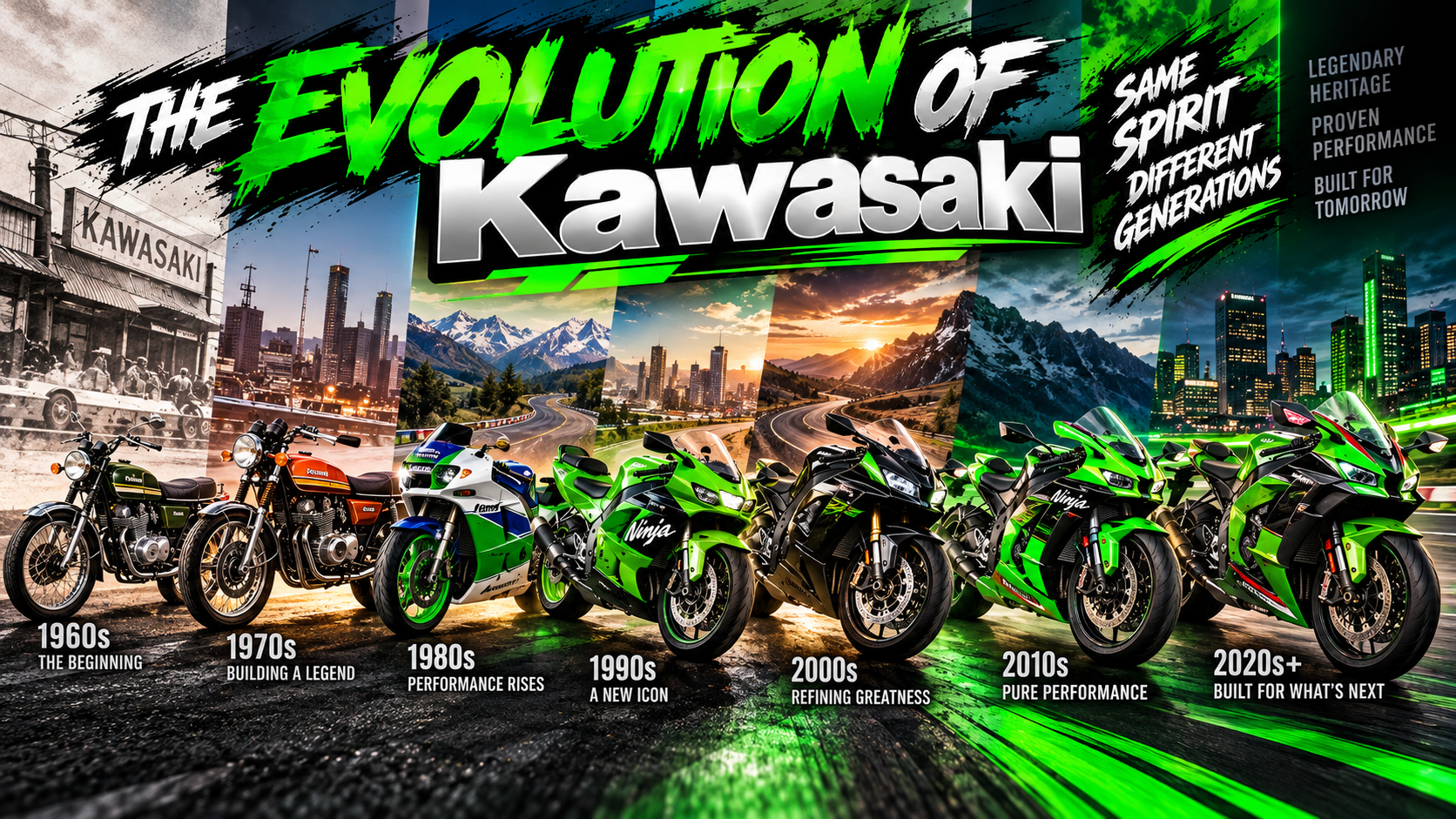
Evolution of Kawasaki Motorcycles is one of the wildest success stories in motorcycle history. What began with industrial engineering and small motorcycle engines eventually became a global motorcycle empire responsible for some of the most recognizable, aggressive, and legendary machines ever to hit the pavement.
Before the Ninja ZX-10R.
Before the ZX-6R.
Before the Z900.
Before the supercharged Ninja H2.
There was a company with a passion for engineering and a willingness to build motorcycles that pushed the limits.
Kawasaki didn’t build its reputation by playing it safe.
It built machines that made people pay attention.
Motorcycles that challenged the competition.
Motorcycles that changed expectations.
And motorcycles that became legends.
At Flip My Cycle in Fayetteville, North Carolina, we appreciate the history behind every machine. Whether it’s a beginner-friendly Ninja 400, a muscular Z900, a track-inspired ZX-6R, or a powerful ZX-10R, every Kawasaki carries decades of engineering development.
So how did Kawasaki go from producing industrial equipment and early motorcycle engines to building some of the most exciting motorcycles on the planet?
Let’s travel through the decades and discover how Team Green became a motorcycle legend.
Table of Contents
- Kawasaki’s Industrial Roots
- The First Kawasaki Motorcycles
- The Legendary Kawasaki H1 Mach III
- The Kawasaki Z1 Changes Everything
- The Birth of the Kawasaki Ninja
- Kawasaki’s Superbike Revolution
- The Rise of the ZX-6R and ZX-10R
- The Kawasaki Z Series and Naked-Bike Revolution
- The Supercharged Kawasaki Ninja H2
- The Future of Kawasaki Motorcycles
- Kawasaki’s Off-Road Legacy
- Why Riders Love Kawasaki
- Kawasaki Motorcycles in Fayetteville NC
- Why Buy Kawasaki From Flip My Cycle?
- The Legacy Continues
1. Evolution of Kawasaki Motorcycles: The Industrial Roots of a Legend
Long before Kawasaki became famous for motorcycles, the company was involved in major industrial engineering projects.
The roots of Kawasaki Heavy Industries trace back to the nineteenth century and the development of Japan’s shipbuilding industry.
Over time, the company’s engineering expertise expanded into aircraft, rail transportation, heavy machinery, and other industrial applications.
That background became an important part of Kawasaki’s motorcycle identity.
While some motorcycle manufacturers began as small bicycle companies, Kawasaki brought experience from large-scale mechanical engineering.
Its expertise in engines, materials, and manufacturing helped shape its approach to motorcycle development.
In 1953, Kawasaki produced its first motorcycle engine, known as the KE-1.
It was a modest beginning compared with the machines Kawasaki would eventually create.
But it represented the start of something extraordinary.
The company was entering an industry where performance, engineering, and innovation would become its defining characteristics.
For Kawasaki’s official historical timeline, explore Kawasaki Heavy Industries Motorcycle History.
2. The First Kawasaki Motorcycles: Building the Foundation
During the early 1960s, Kawasaki began establishing itself as a serious motorcycle manufacturer.
Integrated motorcycle production began in 1960, and the first Kawasaki-brand motorcycle, the B7, followed in 1961.
Early models focused on practical transportation and smaller-displacement engines.
These motorcycles were far removed from today’s high-performance Ninjas.
They were simple.
Affordable.
Mechanical.
And designed for a growing motorcycle market.
Kawasaki also developed a relationship with Meguro, an established Japanese motorcycle manufacturer.
That connection helped expand Kawasaki’s motorcycle engineering experience.
The Kawasaki W1, introduced in the mid-1960s, became an important milestone.
With its large parallel-twin engine and classic styling, it helped establish Kawasaki’s reputation for producing larger motorcycles.
By 1966, Kawasaki had established an American sales operation.
The company was preparing to enter one of the world’s most competitive motorcycle markets.
And American riders were about to discover that Kawasaki had a serious appetite for performance.
3. The 1969 Kawasaki H1 Mach III: When Kawasaki Got Wild
If there was one motorcycle that announced Kawasaki’s arrival in the high-performance world, it was the 1969 Kawasaki H1 Mach III.
This motorcycle was anything but ordinary.
It featured a 498cc air-cooled, two-stroke, three-cylinder engine.
At a time when many motorcycles offered relatively modest performance, the H1 delivered explosive acceleration.
Its engine character was aggressive.
Its exhaust note was unmistakable.
And its performance quickly earned attention.
The H1 became famous for its remarkable straight-line acceleration, helping establish Kawasaki as a manufacturer that wasn’t afraid to build seriously fast motorcycles.
But it also had a reputation for demanding handling characteristics.
Early chassis, suspension, and tire technology couldn’t always match the engine’s enthusiasm.
The result was a motorcycle that required respect.
The H1 Mach III helped establish a formula that would influence Kawasaki for decades.
Build something powerful. Make it exciting. Give riders a machine they’ll never forget.
The H1 wasn’t simply another motorcycle.
It was the beginning of Kawasaki’s performance legend.
4. The 1972 Kawasaki Z1: The Motorcycle That Changed Everything
By the early 1970s, Kawasaki was ready to make another enormous statement.
Enter the Kawasaki Z1 900.
Unveiled in 1972 and sold for the 1973 model year, the Z1 featured a 903cc air-cooled, double-overhead-cam inline-four engine.
This was a major development.
Kawasaki was moving beyond its high-performance two-stroke reputation and demonstrating its ability to build sophisticated four-stroke motorcycles.
The Z1 offered impressive power, distinctive styling, and engineering that helped establish new expectations for large-displacement performance motorcycles.
Its muscular fuel tank, four-cylinder engine, and four exhaust pipes gave it a commanding appearance.
It wasn’t just fast.
It looked powerful standing still.
The Z1 became one of Kawasaki’s most celebrated motorcycles and helped establish the company’s long-running Z-series heritage.
Modern motorcycles such as the Kawasaki Z900 and Z900RS still carry influences from this legendary machine.
The Z1 proved Kawasaki could build motorcycles that were not only exciting but historically important.
For more on the original Z1, visit Kawasaki’s Motorcycle Heritage.
5. The Birth of the Kawasaki Ninja: A New Era Begins
The 1980s transformed motorcycle performance.
Manufacturers began developing increasingly sophisticated engines, aerodynamic fairings, and advanced chassis designs.
Kawasaki was ready.
In 1984, the company introduced the GPz900R, known in the United States as the Ninja 900.
And motorcycle history changed again.
The GPz900R featured a liquid-cooled, 908cc, 16-valve inline-four engine.
It combined impressive performance with technology that represented a major step forward for production sportbikes.
The motorcycle also introduced a name that would become one of the most recognizable in the industry.
Ninja.
That name would eventually appear on everything from approachable entry-level sportbikes to world-class superbikes.
The Ninja 900 also gained popular-culture recognition through its appearance in the 1986 movie Top Gun.
Suddenly, the Ninja wasn’t simply a motorcycle.
It was a symbol of speed, performance, and attitude.
The Ninja name would become one of Kawasaki’s greatest achievements.
6. Evolution of Kawasaki Motorcycles: The Superbike Revolution
During the late 1980s and 1990s, Kawasaki continued pushing motorcycle performance.
The company developed increasingly powerful and sophisticated machines designed for riders who wanted more speed, sharper handling, and cutting-edge technology.
The Kawasaki Ninja ZX-11, introduced for the 1990 model year, became famous for its extraordinary high-speed performance.
It represented Kawasaki’s ability to combine massive power with long-distance sportbike capability.
Then came the Ninja ZX-9R.
Introduced in the 1990s, the ZX-9R offered serious open-class performance while remaining relatively versatile compared with some extreme racing-focused machines.
These motorcycles helped establish Kawasaki’s reputation for building powerful, high-performance sportbikes.
The Ninja lineup was evolving.
From fast street motorcycles into increasingly sophisticated performance machines.
And the next generation would take that evolution even further.
7. The Kawasaki ZX-6R and ZX-10R: Built for Pure Adrenaline
Few Kawasaki motorcycles have earned the level of respect associated with the Ninja ZX-6R and Ninja ZX-10R.
These machines represent decades of supersport and superbike development.
Kawasaki Ninja ZX-6R: The Middleweight Legend
Introduced in the 1990s, the Ninja ZX-6R became a major competitor in the middleweight sportbike category.
It combined a high-revving inline-four engine with aggressive styling and responsive handling.
Over the years, the ZX-6R evolved through changes in engine displacement, chassis design, suspension, braking, and electronic technology.
One of its most recognizable modern configurations uses a 636cc inline-four engine, delivering an exciting balance of midrange response and high-RPM performance.
The ZX-6R developed a loyal following among riders who appreciate precise handling, sharp styling, and supersport character.
Kawasaki Ninja ZX-10R: The Superbike Weapon
The Ninja ZX-10R arrived for the 2004 model year.
It quickly established itself as one of Kawasaki’s premier performance motorcycles.
Its 998cc-class inline-four engine, lightweight chassis, and aggressive engineering made it a serious contender in the liter-bike category.
Over successive generations, Kawasaki refined the ZX-10R with improved aerodynamics, electronics, suspension, braking, and engine performance.
The ZX-10R also became a dominant force in World Superbike racing, particularly during Kawasaki’s championship-winning era with Jonathan Rea.
For riders who love extreme performance, the ZX-10R represents the sharp edge of Kawasaki engineering.
But motorcycles with this level of performance demand experience, discipline, and responsible riding.
The ZX-6R made middleweight performance exciting. The ZX-10R took Kawasaki’s superbike ambitions to another level.
8. The Kawasaki Z Series: Naked Bikes With Serious Attitude
Not every rider wants full fairings and aggressive supersport ergonomics.
Kawasaki recognized that.
And the modern Z series became a major part of its motorcycle lineup.
Motorcycles such as the Z400, Z650, Z900, and Z H2 offer different combinations of power, handling, and everyday usability.
The modern Z-series design language is often described as Sugomi styling.
Sharp lines.
Aggressive front-end designs.
Muscular fuel tanks.
Exposed engines.
And a compact, predatory appearance.
The Kawasaki Z900 became especially popular among riders who wanted strong inline-four performance without the extreme riding position of a full supersport.
The Z650 offered a more approachable middleweight option with a parallel-twin engine.
Meanwhile, the retro-inspired Z900RS brought classic Z1 styling into a modern motorcycle.
The Z series demonstrates how Kawasaki evolved beyond traditional sportbikes while maintaining its performance-oriented personality.
You don’t need a full fairing to experience Kawasaki attitude.
Sometimes an exposed engine and a twist of the throttle are enough.
9. The Supercharged Kawasaki Ninja H2: Engineering Gone Wild
Just when motorcycle enthusiasts thought Kawasaki had explored every possible performance direction, the company introduced something extraordinary.
The Kawasaki Ninja H2.
Introduced for the 2015 model year, the Ninja H2 brought factory supercharging to an exceptionally high-performance production motorcycle.
Instead of relying only on engine displacement and naturally aspirated power, Kawasaki developed an integrated supercharger system.
The result was a motorcycle unlike almost anything else on the road.
Its aggressive bodywork, distinctive styling, and advanced engineering made the H2 instantly recognizable.
The Ninja H2R, designed for closed-course use, pushed the concept even further.
It represented an extreme demonstration of what Kawasaki engineers could achieve when focused on maximum performance.
The H2 family became a symbol of Kawasaki’s willingness to explore unconventional engineering solutions.
Decades after the H1 Mach III shocked riders with its two-stroke acceleration, Kawasaki had once again created a motorcycle that demanded attention.
Different technology.
Different era.
Same obsession with performance.
10. The Future of Kawasaki Motorcycles: Hybrid, Electric, and Beyond
The Evolution of Kawasaki Motorcycles isn’t finished.
Motorcycle technology continues changing, and Kawasaki has explored new approaches to performance, efficiency, and rider experience.
Recent developments have included electric motorcycles such as the Ninja e-1 and Z e-1, along with hybrid models such as the Ninja 7 Hybrid and Z7 Hybrid.
These machines demonstrate Kawasaki’s interest in combining traditional motorcycle engineering with new propulsion technologies.
Hybrid motorcycles introduce a different approach to balancing internal-combustion power and electric assistance.
Electric motorcycles offer another kind of riding experience, with electric-motor response and different maintenance considerations.
Meanwhile, Kawasaki continues developing traditional gasoline-powered motorcycles.
Sportbikes.
Naked bikes.
Cruisers.
Adventure motorcycles.
Dual-sport machines.
The future isn’t necessarily about abandoning the motorcycles riders already love.
It’s about expanding the possibilities.
And if Kawasaki’s history teaches us anything, it’s that the company is rarely content to stop experimenting.
11. Kawasaki’s Off-Road Legacy: Built Beyond the Pavement
Kawasaki’s reputation isn’t limited to street motorcycles.
The company has a long history in motocross, trail riding, and off-road competition.
The KX series became one of Kawasaki’s most recognizable motocross families.
Kawasaki’s off-road racing achievements helped build the Team Green identity.
Over the decades, KX motorcycles earned championship success and developed a strong following among competitive riders.
Meanwhile, the KLX lineup brought Kawasaki engineering to trail riding and dual-sport use.
Motorcycles such as the KLX110, KLX230, and KLX300 offer different riding experiences for different skill levels and environments.
The Kawasaki KLR650 became another legendary name, valued by many riders for its adventure-oriented versatility and straightforward design.
These machines show that Kawasaki’s history is about more than horsepower and pavement.
It’s also about dirt.
Trails.
Adventure.
And the desire to explore beyond ordinary roads.
12. Why Riders Love Kawasaki Motorcycles
Ask Kawasaki enthusiasts why they love the brand, and you’ll hear different answers.
Some love the Ninja styling.
Some love the inline-four engine sound.
Some love the raw personality of the Z900.
Others appreciate the practicality of a Ninja 400 or Ninja 650.
And some riders have spent decades riding Kawasaki motorcycles because of their familiarity with the brand.
But several themes come up repeatedly.
Performance
Kawasaki has built a reputation around exciting engines and engaging riding experiences.
Variety
From smaller-displacement street motorcycles to heavyweight cruisers, off-road bikes, and superbikes, Kawasaki offers a broad range of motorcycle styles.
Racing Heritage
Decades of competition have helped shape the company’s engineering and public identity.
Distinctive Styling
Kawasaki’s aggressive Ninja and Z-series designs are instantly recognizable.
Motorcycle Community
Kawasaki ownership connects riders through motorcycle clubs, group rides, racing events, and shared enthusiasm.
Every rider has a different reason for choosing Kawasaki.
But the common thread is a love of riding.
13. Kawasaki Motorcycles in Fayetteville NC: A Legacy You Can Experience
You don’t have to travel to Japan to appreciate Kawasaki’s motorcycle history.
You can experience that legacy right here in North Carolina.
For riders around Fayetteville, Fort Bragg, Hope Mills, Spring Lake, Raeford, Rockfish, Sanford, Southern Pines, Pinehurst, Lumberton, Wade, Stedman, Eastover, and Cumberland County, Kawasaki motorcycles offer a wide variety of riding experiences.
Maybe you’re interested in the lightweight handling of a Ninja 400.
Maybe you prefer the everyday versatility of a Ninja 650.
Maybe the Z900’s muscular styling and inline-four engine are exactly what you’re looking for.
Or maybe you’ve always wanted to experience the aggressive character of a ZX-6R.
Different riders.
Different motorcycles.
Different experiences.
But every Kawasaki connects back to the company’s long history of innovation.
Whether you’re commuting around Fayetteville or planning a weekend ride through the Sandhills, the right motorcycle can make every mile more enjoyable.
For professional rider training and safety information, visit the Motorcycle Safety Foundation.
14. Why Buy a Kawasaki Motorcycle From Flip My Cycle?
At Flip My Cycle, we appreciate motorcycles with history, personality, and performance.
Kawasaki has spent decades building machines that riders recognize and respect.
From approachable street motorcycles to serious sportbikes, the Kawasaki name represents a broad range of riding experiences.
We’re a veteran-owned motorcycle dealership located at 6216 Yadkin Road in Fayetteville, North Carolina.
We serve motorcycle enthusiasts throughout Fayetteville, Fort Bragg, Hope Mills, Spring Lake, Raeford, Rockfish, Sanford, Southern Pines, Pinehurst, Lumberton, and surrounding communities.
Whether you’re purchasing your first motorcycle, trading your current ride, or searching for something with more performance, finding the right motorcycle matters.
Looking for a Kawasaki Ninja?
Interested in a Z650 or Z900?
Dreaming about a ZX-6R or ZX-10R?
Explore our used motorcycle inventory at Flip My Cycle to see which motorcycles are currently available.
Because the next chapter of Kawasaki’s history might begin with the motorcycle you bring home.
15. Evolution of Kawasaki Motorcycles: The Legacy Continues
The Evolution of Kawasaki Motorcycles is a story of bold engineering, legendary performance, and motorcycles that helped change the industry.
From the early motorcycle engines of the 1950s to the first Kawasaki-brand motorcycles of the 1960s, the company built a foundation that would support generations of innovation.
Then came the machines that made history.
1969 Kawasaki H1 Mach III: The two-stroke triple that established Kawasaki’s high-performance reputation.
1972 Kawasaki Z1: The 903cc four-cylinder superbike that helped redefine motorcycle performance.
1984 Kawasaki Ninja 900: The machine that introduced the Ninja name to the world.
1990 Kawasaki Ninja ZX-11: A high-speed performance legend.
1990s Kawasaki Ninja ZX-6R: A new chapter in middleweight supersport history.
2004 Kawasaki Ninja ZX-10R: A liter-class superbike built for serious performance.
Modern Kawasaki Z Series: Naked motorcycles with aggressive styling and everyday versatility.
2015 Kawasaki Ninja H2: Supercharged engineering taken to an extraordinary level.
Modern Kawasaki KX and KLX models: Continuing the company’s off-road heritage.
Electric and hybrid Kawasaki motorcycles: New approaches to the future of riding.
Through every generation, Kawasaki has continued experimenting, competing, and developing motorcycles that excite enthusiasts.
And while the technology has changed dramatically, the passion behind the machines remains familiar.
At Flip My Cycle in Fayetteville NC, we believe the best way to appreciate motorcycle history is to experience the ride for yourself.
From two-stroke legends to supercharged monsters, Kawasaki didn’t just follow motorcycle history. It helped write it.
Team Green. Legendary machines. Decades of adrenaline.


