
History of Motorcycles: From Steam-Powered Bicycles to Two-Wheeled Legends
History of Motorcycles is a story of invention, rebellion, innovation, speed, and the relentless human desire to go farther than ever before. Long before motorcycles became symbols of freedom and adventure, they began as experimental machines built by inventors who wondered what would happen if they attached an engine to a bicycle.
What started as a mechanical experiment eventually became one of the most exciting forms of transportation ever created.
Today, motorcycles represent everything from transportation and racing to personal freedom, craftsmanship, and community.
But how did we get here?
How did a simple bicycle evolve into a Harley-Davidson touring machine, a Suzuki Hayabusa, a Kawasaki Ninja ZX-10R, or a modern Triumph sportbike?
And who was the first person to look at two wheels and think, “This thing needs an engine”?
At Flip My Cycle in Fayetteville, North Carolina, we believe understanding motorcycle history makes riding even more meaningful.
Because every motorcycle on the road today carries a little piece of the past.
Let’s fire up the time machine and discover how motorcycles became the legends we know today.
Table of Contents
- Before Motorcycles: The Bicycle Revolution
- The First Motorized Two-Wheelers
- The 1885 Daimler Reitwagen
- The First Production Motorcycles
- Indian and Harley-Davidson Enter the Scene
- Motorcycles During the World Wars
- The Rise of Motorcycle Racing
- The Japanese Motorcycle Revolution
- The Birth of Modern Superbikes
- Motorcycles Become a Global Lifestyle
- The Evolution of Motorcycle Technology
- The History of Motorcycles in America
- How Motorcycle Culture Changed the World
- Legendary Motorcycles That Made History
- The Future of Motorcycles
- Why Motorcycle History Matters at Flip My Cycle
1. History of Motorcycles: Before Engines, There Were Bicycles
Before motorcycles existed, bicycles were already changing the way people traveled.
During the early 1800s, inventors experimented with human-powered two-wheeled transportation.
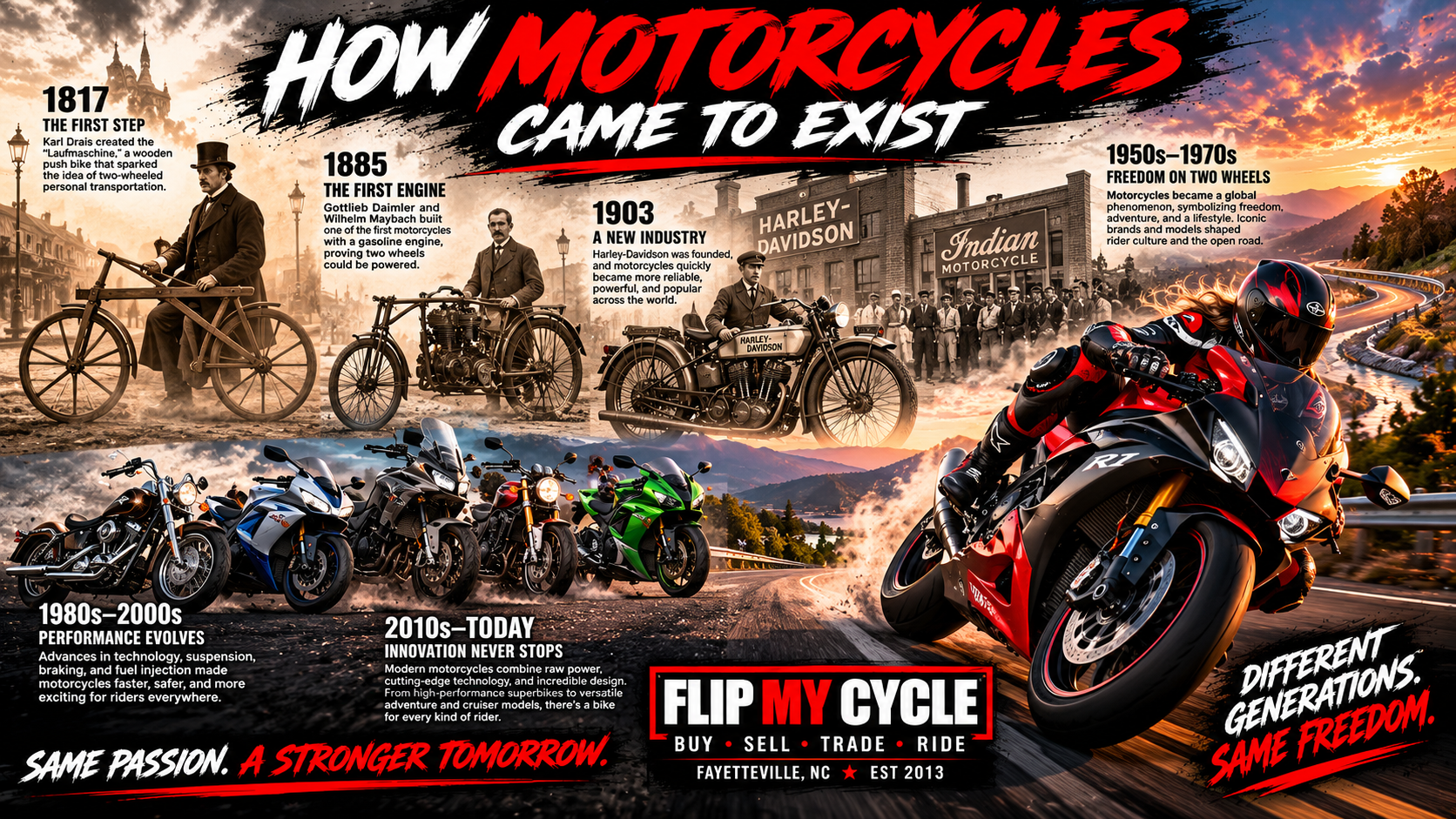
In 1817, German inventor Karl Drais introduced a two-wheeled running machine often called the Draisine.
It didn’t have pedals.
It didn’t have an engine.
Riders pushed themselves forward using their feet.
It might look strange compared with a modern motorcycle, but it helped establish an important idea.
Two wheels could provide practical personal transportation.
Over the following decades, bicycle technology improved.
Pedals were introduced.
Frames became stronger.
Wheels became more efficient.
And inventors began exploring ways to travel without relying entirely on human muscle power.
Eventually, someone asked the question that changed everything.
What if we added an engine?
2. The First Motorized Two-Wheelers: Steam Before Gasoline
Most people imagine the first motorcycle having a gasoline engine.
But early motorcycle history is more complicated.
During the 1860s, inventors began experimenting with steam-powered two-wheeled machines.
One early example is associated with French inventor Pierre Michaux’s workshop and engineer Louis-Guillaume Perreaux.
Their steam-powered velocipede experiments are often dated to the late 1860s.
Around the same period, American inventor Sylvester H. Roper developed steam-powered riding machines.
These early vehicles were far removed from modern motorcycles.
They were heavy.
They were mechanically complicated.
And steam engines required heat, water, and pressure to operate.
But they proved something important.
A two-wheeled vehicle could move using mechanical power instead of pedals.
The dream of the motorcycle was becoming real.
3. The 1885 Daimler Reitwagen: The Motorcycle’s Gasoline-Powered Breakthrough
When people ask who invented the motorcycle, one name frequently comes up.
Gottlieb Daimler.
In 1885, Daimler and Wilhelm Maybach developed the Daimler Reitwagen in Germany.
This experimental vehicle used an internal-combustion engine and is widely recognized as an important early gasoline-powered motorcycle.
However, it wasn’t the first powered two-wheeler of any kind.
Steam-powered predecessors existed earlier.
The Reitwagen also used small stabilizing wheels, making its design different from modern motorcycles.
Still, it represented a major breakthrough.
Instead of depending on steam, the machine demonstrated the possibilities of a compact gasoline engine.
That concept would eventually reshape transportation.
Imagine seeing one of these machines in 1885.
No modern highways.
No motorcycle dealerships.
No racing championships.
No riding clubs.
Just an unusual motorized contraption that looked like something from the future.
The motorcycle revolution was beginning.
For more information about the early history of Daimler’s engineering, visit Mercedes-Benz.
4. The First Production Motorcycles: Turning Experiments Into Transportation
By the 1890s, motorcycles were moving beyond experimental prototypes.
Inventors and manufacturers began developing machines that could be sold to customers.
In 1894, Hildebrand & Wolfmüller introduced a motorcycle that is widely recognized as the first production motorcycle marketed under the name Motorrad.
This was a significant milestone.
Motorcycles were no longer just strange mechanical experiments.
They were becoming commercial products.
Early production motorcycles were nothing like modern machines.
They often lacked sophisticated suspension.
Braking systems were primitive.
Engines were small and unreliable by modern standards.
And starting them could be an adventure all by itself.
But people were fascinated.
For the first time, the possibility of owning a motorized two-wheeled vehicle was becoming real.
Motorcycle manufacturers soon appeared throughout Europe and the United States.
The race to build better machines had begun.
5. Indian and Harley-Davidson: American Motorcycle Legends Are Born
The early 1900s brought two names that would help define American motorcycle culture.
Indian Motorcycle and Harley-Davidson.
Indian’s origins date to 1901, when George M. Hendee and Oscar Hedstrom developed the business that became one of America’s most recognizable motorcycle manufacturers.
Indian motorcycles quickly gained attention for their engineering, performance, and racing achievements.
Then, in 1903, Harley-Davidson began its story in Milwaukee, Wisconsin.
William S. Harley and the Davidson brothers helped establish a brand that would eventually become synonymous with American motorcycle culture.
Early Harley-Davidson motorcycles were relatively simple machines.
But over the decades, the company became famous for its V-twin engines, distinctive styling, and loyal following.
Indian and Harley-Davidson competed in engineering, racing, sales, and reputation.
That rivalry helped shape the American motorcycle industry.
More than a century later, both names remain important parts of motorcycle history.
Explore their official histories at Harley-Davidson and Indian Motorcycle.
6. Motorcycles During the World Wars
Motorcycles played important roles during both World War I and World War II.
Military forces needed transportation that was faster and more maneuverable than many traditional vehicles.
Motorcycles were used for dispatch riders, reconnaissance, communication, and other support duties.
During World War I, manufacturers supplied motorcycles to military organizations.
During World War II, motorcycles such as the Harley-Davidson WLA and various BMW and British military models became associated with wartime transportation.
These machines weren’t built for weekend cruising.
They were working vehicles.
They transported messages.
Carried equipment.
And operated in demanding conditions.
Military motorcycle use also influenced later design and manufacturing developments.
After the wars, returning service members and civilian riders helped expand motorcycle ownership and culture.
For some, riding represented practical transportation.
For others, it represented freedom and adventure.
7. The Rise of Motorcycle Racing
Motorcycle racing became popular surprisingly early.
As soon as manufacturers started building motorcycles, riders wanted to know which machine was fastest.
Competition encouraged innovation.
Manufacturers experimented with stronger engines, better frames, improved tires, and more effective brakes.
Early motorcycle competitions included road races, endurance events, and track racing.
The Isle of Man Tourist Trophy began in 1907 and became one of the most famous motorcycle racing events in history.
Over time, motorcycle racing developed into many disciplines.
Road racing.
Motocross.
Flat track.
Drag racing.
Endurance racing.
Superbike competition.
Grand Prix racing.
These events helped push motorcycle technology forward.
Innovations developed for competition often influenced production motorcycles.
Today, racing remains a major part of motorcycle culture.
For modern Grand Prix racing information, visit MotoGP.
8. The Japanese Motorcycle Revolution
One of the biggest turning points in the History of Motorcycles came during the middle of the twentieth century.
Japanese manufacturers began transforming the motorcycle industry.
Honda.
Yamaha.
Suzuki.
Kawasaki.
These brands introduced motorcycles that emphasized reliability, engineering innovation, competitive pricing, and accessible performance.
Honda’s Super Cub, introduced in 1958, became one of the most influential motorcycles ever produced.
It made powered two-wheel transportation practical for millions of people.
Then came another landmark.
The 1969 Honda CB750.
Its transverse inline-four engine, electric starting, and front disc brake helped redefine expectations for a production motorcycle.
The CB750 became closely associated with the rise of the modern superbike.
Japanese manufacturers continued improving motorcycle technology throughout the 1970s, 1980s, and beyond.
Their competition reshaped the global motorcycle market.
For motorcycle enthusiasts today, the legacy is obvious.
The Kawasaki Ninja.
Suzuki GSX-R.
Yamaha YZF-R.
Honda CBR.
These famous motorcycle families grew out of decades of Japanese engineering and competition.
9. The Birth of Modern Superbikes
During the 1980s and 1990s, motorcycle performance entered a new era.
Manufacturers began producing increasingly sophisticated sportbikes.
One of the most influential motorcycles was the 1985 Suzuki GSX-R750.
Its race-inspired design helped establish the template for the modern lightweight, fully faired sportbike.
Then came machines such as the Honda CBR900RR FireBlade, introduced in 1992.
The FireBlade emphasized an exciting combination of power and relatively low weight.
Kawasaki developed its Ninja performance family.
Yamaha introduced increasingly advanced sportbikes, including the YZF-R1 in 1998.
And Suzuki continued refining the GSX-R series.
The sportbike revolution changed what riders expected from production motorcycles.
High-performance engines.
Lightweight frames.
Advanced suspension.
Aerodynamic bodywork.
Powerful braking systems.
And handling designed for precision.
The motorcycles that once seemed impossibly futuristic became machines enthusiasts could actually purchase.
10. Motorcycles Become a Global Lifestyle
Motorcycles eventually became much more than transportation.
They became part of popular culture.
Movies, music, racing, fashion, and travel helped establish motorcycles as symbols of independence.
The 1953 film The Wild One, starring Marlon Brando, helped shape the popular image of motorcycle rebellion.
The 1969 film Easy Rider became another cultural milestone.
Motorcycles represented adventure, personal identity, and the desire to travel beyond familiar boundaries.
But motorcycle culture is much broader than Hollywood stereotypes.
It includes commuters.
Touring enthusiasts.
Sportbike riders.
Adventure riders.
Cruiser owners.
Collectors.
Restoration specialists.
Racers.
And people who simply enjoy a quiet ride on a beautiful afternoon.
Motorcycles bring together individuals from different backgrounds through a shared interest.
The machine may change.
The reason people ride often remains surprisingly similar.
11. The Evolution of Motorcycle Technology
The difference between an early motorcycle and a modern motorcycle is extraordinary.
Early machines relied on basic mechanical systems.
Modern motorcycles can feature advanced electronics and sophisticated engineering.
Important developments include:
- Electric starting systems
- Electronic fuel injection
- Disc brakes
- Anti-lock braking systems
- Traction control
- Electronic riding modes
- Ride-by-wire throttles
- Advanced suspension systems
- Quickshifters
- Lightweight aluminum frames
- Improved tire technology
- LED lighting
- Digital instrumentation
- Smartphone connectivity
- Electronic cruise control
Some modern motorcycles even use sophisticated sensors to adjust electronic systems based on riding conditions.
These technologies have changed how motorcycles perform and how riders interact with them.
But even with all that innovation, the basic appeal remains familiar.
An engine.
Two wheels.
A rider.
And the open road.
12. The History of Motorcycles in America
Motorcycles became part of American transportation during the early twentieth century.
They were used for commuting, police work, delivery services, military duties, and recreation.
As automobile ownership expanded, motorcycles increasingly developed a recreational identity.
Cruiser culture became especially important in the United States.
Harley-Davidson and Indian Motorcycle helped define American motorcycle styling.
Long wheelbases.
V-twin engines.
Low seating positions.
Distinctive exhaust sounds.
And strong customization traditions.
Over time, American motorcycle culture expanded to include Japanese sportbikes, European motorcycles, adventure bikes, and modern touring machines.
Today, motorcycle enthusiasts can choose from an enormous variety of styles.
The American motorcycle story isn’t limited to one brand or one type of rider.
It’s a constantly evolving community.
13. How Motorcycle Culture Changed the World
The motorcycle didn’t just change transportation.
It changed how people experienced travel.
Motorcycles made personal mobility more accessible in many parts of the world.
They became important tools for work and commuting.
They created new racing industries.
They inspired businesses, clubs, rallies, and communities.
They encouraged innovation in engines, suspension, tires, and safety equipment.
And they helped establish a unique form of personal expression.
Motorcycle enthusiasts developed traditions that continue today.
Group rides.
Bike nights.
Charity events.
Motorcycle rallies.
Road trips.
Custom builds.
And the familiar wave between passing riders.
Those traditions remind us that motorcycle ownership is often about more than the machine.
It’s about belonging to something larger.
14. Legendary Motorcycles That Made History
Throughout motorcycle history, certain machines have become especially influential.
Harley-Davidson Knucklehead
Introduced in 1936, Harley-Davidson’s overhead-valve Knucklehead V-twin became one of the company’s most celebrated engine designs.
Indian Chief
The Indian Chief became one of the most recognizable American motorcycle models, known for its distinctive styling and V-twin heritage.
Triumph Bonneville
Introduced in 1959, the Triumph Bonneville became an icon of British motorcycle culture.
Its classic styling continues influencing modern Triumph motorcycles.
Honda CB750
Introduced in 1969, the Honda CB750 helped establish new expectations for high-performance production motorcycles.
Suzuki GSX-R750
The 1985 GSX-R750 helped redefine the modern sportbike.
Its racing-inspired design influenced generations of supersport motorcycles.
Honda CBR900RR FireBlade
The 1992 FireBlade emphasized lightweight construction and serious performance, changing expectations for large-displacement sportbikes.
Yamaha YZF-R1
Introduced in 1998, the Yamaha R1 became one of the most influential modern superbikes.
Suzuki Hayabusa
Introduced in 1999, the Suzuki Hayabusa became famous for its aerodynamic styling and extraordinary high-speed performance.
Kawasaki Ninja H2
Introduced for the 2015 model year, the supercharged Kawasaki Ninja H2 demonstrated another level of engineering innovation in high-performance motorcycles.
Every one of these machines helped shape the motorcycles we know today.
15. The Future of Motorcycles
Motorcycle technology continues evolving.
Electric motorcycles are expanding the possibilities of two-wheeled transportation.
Manufacturers are developing new battery systems, electric drivetrains, and connected technologies.
Advanced rider-assistance systems are also becoming more common on certain models.
But the future of motorcycles isn’t necessarily about replacing everything that came before.
Many riders still appreciate traditional engines, manual transmissions, classic styling, and mechanical simplicity.
That’s what makes the motorcycle industry interesting.
It continues moving forward while preserving its history.
A modern electric motorcycle and a vintage Harley-Davidson can represent completely different technologies while sharing the same basic appeal.
Personal freedom on two wheels.
16. History of Motorcycles: From the First Engine to Flip My Cycle
The History of Motorcycles began with inventors experimenting with powered bicycles.
Over the decades, those experiments evolved into machines that transformed transportation, motorsports, and popular culture.
Today, motorcycle enthusiasts can choose from countless styles and manufacturers.
At Flip My Cycle, we’re proud to be part of that continuing story.
Our veteran-owned motorcycle dealership in Fayetteville, North Carolina, serves riders throughout Fort Bragg, Hope Mills, Spring Lake, Raeford, Rockfish, Sanford, Southern Pines, Pinehurst, Lumberton, Wade, Stedman, Eastover, and surrounding communities.
Whether you love the timeless character of a Harley-Davidson, the excitement of a Kawasaki Ninja, the legendary performance of a Suzuki Hayabusa, the precision of a Yamaha sportbike, or the heritage of a Triumph, every motorcycle carries part of this history.
And every rider adds another chapter.
Explore our motorcycle inventory at Flip My Cycle and discover a machine that could become part of your own story.
From steam-powered experiments to modern superbikes, motorcycles have always represented one thing: the desire to keep moving forward.
The machines have changed. The technology has evolved. But the love of riding remains.

